From Fr. Thomas Walsh's History of the Irish hierarchy: with the monasteries of each county, biographical notices of the Irish Saints, prelates, and religious, 1856, c. xx, pps. 196-200.
Bishops of Cashel
Its founder Cormac MacCullenan king of Munster and bishop of Cashel. His transactions already noticed.
Donald O'Hene who sat in Cormac's chair died in the year 1098 according to the Four Masters who say of him that he was descended of the family of the Dalcassians that he was the fountain of religion in the western parts of Europe second to no Irishman in wisdom and piety, that he was the most learned doctor of Ireland in the Roman law and died on the 1st of December. He assisted at a council held in Ireland AD 1096 in which Waterford was erected into a bishopric.
Miler O'Dunan died at Clonard on the 24th of December 1118 in the seventy seventh year of his age and the most pious man in the western world.
Malisa O'Foglada died in 1131.
Donatus O Conding died in 1137. He was a prelate celebrated for his devotion wisdom and alms deeds.
Donatus O'Lonargan I sat in 1152 and departed life in 1158. In the annals of the Island of All Saints, Donatus is styled arch-elder of Munster, a learned and liberal man especially to the poor. In the incumbency of Donatus, the see of Cashel was raised to the rank of metropolitan at the synod of Kells held in 1152.
Donald O'Hullucan succeeded in 1158.
During his incumbency a synod was held at Cashel by command of King Henry in which Christian O'Conarchy, the legate of Ireland and bishop of Lismore, presided in order to regulate some affairs of ecclesiastical discipline. It has been said that the archbishops and bishops of Ireland, besides the abbots, attended but it is certain that the primate Gelasius or his suffragans of Ulster did not attend, if we may except the bishop of Clogher. The archbishops of Dublin, Cashel and Tuam are said to have assisted with their suffragans, abbots and archdeacons. On the part of Henry were Ralph, archdeacon of Landaff, his chaplain Nicholas and some other ecclesiastics. First decree for the reformation of the abuses prevalent in the Irish church and which the emissaries of England were so intent on reforming, that children should be brought to the church and baptized there in clean water with the triple immersion and that this act should be performed by the priests unless in cases of imminent danger of death and then by any one without distinction of sex or order.
2d It was ordered that tithes should be paid to the churches out of every sort of property.
3d That all laymen who wish to take wives should take them according to the canon law which prohibited marriages within certain degrees of consanguinity or affinity.
4th That all ecclesiastical lands and property connected with them should be exempt from the exactions of laymen.
5th That in case of murder by laymen and of composition on their part with their enemies clergymen the relations of such are not to pay part of the fine &c.
6th That all the faithful lying in sickness do in the presence of their confessor and neighbors make their will with due solemnity.
7th That due respect be paid to those who die after a good confession by means of Masses, vigils and decent burial and likewise that all divine matters be henceforth conducted agreeably to the practices of the holy Anglican Church.
These decrees, the only ones that emanated from the synod, were confirmed by the king and subscribed by its members. Such an important reform in the abuses of the Irish Church must have been highly gratifying to the royal zeal of Henry who was, sometime before, accessory to the death of St Thomas a Becket, because that holy prelate would not allow him to invade the sanctuary of the church which he was bound to protect and defend. In the transactions of the synod his stipulation with Pope Adrian concerning the payment of Peter pence is entirely lost sight of but the crafty monarch in order to gain them over to his views paid great attention to the privileges and immunities of the clergy, though he had been laboring at home to circumscribe the rights of their brethren in England. The canons of this council, the ones relative to baptism and to the celebration of marriage, form the groundwork of slander against the Irish Church. Another clerical defamer, John Brompton, a Cistercian monk, introduces a barefaced calumny on the subject of marriage. Hitherto, Lanfranc nor Anselm of Canterbury, nor St. Bernard nor Gerald Barry accuse the Irish with polygamy, they may have complained against the practice of marrying within the prohibited degrees nor was it an easy undertaking to put a stop to these intermarriages in Ireland because of the system of clanship and of the Irish laws relative to the right by which landed property was held and to the rules of succession thereto. The charge of polygamy is an atrocious one invented for the sole purpose of vilifying the Irish people. There is not the least foundation for it in any portion of the ecclesiastical history of Ireland.
With regard to the administration of baptism it was conferred in the churches when Christianity was well established. Thus it is mentioned in the life of St. Finnian that some women were carrying him to the church of Roscur to be there baptized by the bishop Forchern and that they were met by a St. Abban who stopped those females and baptized Finnian in the water of two united rivers. St. Patrick used to baptize his converts in rivers lakes and fountains. It is also related of St. Senan that his parents took him to the church. Some negligence may have crept in with regard to the conferring of baptism out of the churches, which the synod wished to redress.
Another abuse which is alleged was that of baptizing the children of the rich in milk instead of water. St. Adamnan, in his life of Columbkille, relates that when he was traveling through the country of the Picts an infant was presented by his parents for baptism and that as there was no water in the neighborhood the Saint prayed for a while upon a rock and blessed a part of it whence water immediately flowed in abundance with which he baptized the infant. Had the practice of baptizing with milk prevailed among the Irish, how has it escaped St. Bernard, Lanfranc or Anselm and above all the searching eye of Gerald Barry. St. Jerome observes that milk and wine the former denoting their innocence used to be given to newly baptized infants, in the western churches in some churches honey was given instead of wine. A similar custom in Ireland could be mistaken or misrepresented, nor is it true that the Irish people were careless in having their children baptized by clergymen. St. Fursey was three days after his birth baptized by St. Brendan of Clonfert. St. Fintan of Cluain edneach, on the eighth day of his birth, was baptized by a holy man who lived in a place called Cluain mic treoin. St. Lawrence O'Toole was baptized by the bishop of Kildare. In the 24th and 27th canons of the Synod called that of St. Patrick, Auxilius and Iserninus, it is ordered that no stranger do baptize or offer the holy mysteries without the permission of the bishop.
King Henry sent to the Pope certain letters it is said of all the archbishops and bishops of Ireland the synod having terminated its labors recognizing his power over the nation. We have already seen that the Primate Gelasius and his suffragans did not attend the synod of Cashel. He may have at a later period forwarded letters containing copies of those admirable decrees and an account of certain practices which might induce the pontiff to sanction his views. Be this as it may the decrees produced no effect in Ireland and were disregarded by the Irish clergy as if the synod had never been convoked. The Archbishop Donald in whose incumbency those transactions took place died in the year 1182. Three years before his death Cashel was destroyed by fire.
Maurice succeeded in 1182 and died in 1191, was a man of learning and wisdom according to Cambrensis Gerald having taunted the Irish Church with having no martyrs the archbishop replied. Though says he our country be looked upon as barbarous uncultivated and cruel yet they always have paid reverence and honor to ecclesiastics and never could stretch out their hands against the saints of God. But now there is come a people who know how and are accustomed to make martyrs. Henceforth Ireland like other countries shall have hers.
Mathew O'Heney succeeded in 1192 and was appointed legate apostolic of Ireland by Pope Celestine III. Mathew was a Cistercian monk He convened a synod at Dublin in the year of his appointment and at which the best men of Ireland attended. Mathew was the author of the life of St. Cuthbert, bishop of Lindisfarne, whom English writers claim as a native of England. He was born at Kells in the county of Meath according to the annals of St Mary's Abbey near Dublin. But it is more probable that he was born in the kingdom of Northumbria. Benedict XIV in his decree regarding the offices of Irish saints enumerates St. Cuthbert among the national ones of Ireland. In the annals Four Masters is recorded the following eulogy of the illustrious Mathew O'Heney in the year 1206: "Mathew archbishop of Cashel and legate of Ireland, the wisest and most religious man of the natives of that country, having founded many churches having triumphed over the old enemy of mankind by working many miracles, voluntarily abandoning all worldly pomp happily went to rest in the Abbey of the Holy cross in the county of Tipperary."
Donagh O'Lonergan II a Cistercian monk succeeded in 1206. Pope Innocent III gave him the pallium and confirmed the possessions of the see of Cashel on the 6th of April 1210. In the Pope's letters Donatus receives instructions as to his behavior in so holy a clothing and the pontiff points out the festivals on which he should wear this badge of dignity and jurisdiction and moreover desires when he or any of his suffragans should die that their pastoral staff and ring should remain in its proper church under a faithful guardian for the use of the successor. That he should take care the churchyards and ecclesiastical benefices should not be possessed by hereditary right and should any attempt of this sort be made to have them restrained by ecclesiastical censures. The annals of Ulster affirm that this archbishop assisted at the council of Lateran in Rome AD 1215 and died there, yet it is said that he was buried in the conventual church of Cisteaux in Burgundy on the gospel side of the great altar.
Donat O'Lonargan III succeeded in 1216. He is said to have erected Cashel into a borough and to have given burgage holdings to the burgesses. Donatus with the consent of the Pope resigned the archbishopric in 1223. Some time before his resignation he interdicted the king's tenants and lands within his diocese upon which the king appealed to Pope Honorius III who enjoined Donatus to relax the interdict in fifteen days and in case of refusal authorized the bishops of Kildare, Meath and Ossory to do so. He survived his abdication nine years and died in 1232.
Showing posts with label St. Patrick. Show all posts
Showing posts with label St. Patrick. Show all posts
Saturday, 23 March 2019
Monday, 3 July 2017
St. Patrick's Mission at Cashel and through Munster

From Fr. Thomas Walsh's Ecclesiastical History of Ireland c. xx, pps. 188-192
St. Patrick having finished his mission at Ossory proceeded without delay to Cashel where the kings of the province usually resided. On approaching the city it is related that the king came to greet him and having given him a welcome salutation conducted the apostle to his court. The period assigned to the transactions of St. Patrick in Munster is about the beginning of the year 445. The king who thus cordially received the saint is said to have been Aengus, the son of Natfraich, a prince who has been for his zeal and piety highly commended by many ancient writers. Although his conversion cannot be controverted yet his accession to the throne seems to belong to a later period as the king Aengus was killed in the battle of Carlow which was fought according to the Four Masters AD 489. Aengus must have been then very young and it is probable that the prince or king of Cashel who paid attention to St. Patrick was Natfraich himself. Though he is not spoken of as a convert to the Christian faith yet he might have shown this courtesy to the apostle as a stranger of rank and one who was so particularly favored with the protection of Heaven and have permitted him to preach the gospel to his subjects as well as instruct his own children. However, this be Aengus was instructed in the faith and on his accession to the throne which he occupied thirty six years became highly instrumental in spreading the faith throughout Munster.
The celebrated anecdote of the prince's foot having been pierced by the staff of St Patrick it seems did not occur in the act of baptism as the sacred rite was then administered by immerson but rather when the saint was imparting his blessing to Aengus who approached too closely to the apostle in his desire to obtain such a favor. The prince when asked by St. Patrick why he had not given some indication of the pain he had felt replied that he submitted to the piercing of his foot as a part of the ceremony and accordingly bore it with patience.
St. Patrick it is said converted several other persons of distinction at Cashel and after this prosperous beginning at head quarters set out for other regions of the province preaching the gospel baptizing new converts reviving the faith of those who were already Christians erecting churches and appointing pastors. Hence we can legitimately infer that St. Patrick had some precursors in the southern parts as there were Christians in Ireland before the arrival of St Palladius, the predecessor of St Patrick. It is said that a synod was then held at Cashel and that certain regulations were entered into regarding the sees of Cashel, Ardmore, Saigir and Begerin, over which Ailbe, Declan, Kieran and Iber presided before the arrival of St. Patrick. Had such proceedings taken place they would not be omitted in all the lives of St. Patrick and again none of those saints was raised to the dignity of bishop at this early stage of St. Patrick's preaching in the south of Ireland.
That there had been some murmuring against himself the apostle hints in his confessions probably originating in a spirit of jealousy which might have influenced some of the Christians who were there prior to his mission and perhaps some of those cavillers belonged to the clerical order as St. Patrick wished to impress that he had with great risk visited even the remotest places into which no missionary had ever before penetrated.
The first district which St. Patrick visited after his departure from Cashel was seemingly the extensive and flat country between Cashel and Limerick. Here he is said to have founded several churches and to have left some of his disciples to preside at one of them called Kill fheacla. Thence he went to the territory of Ava Cliach in the now counties of Tipperary and Limerick in a part of which, the barony of Coonagh, he was at first violently opposed by the dynast Olild but, in consequence of a miracle which was in accordance with St. Patrick's orders to his disciples Ailbe and Ibar obtained through their prayers, the dynast his family and subjects are said to have been converted and baptized. While the apostle remained in the territory of Ara Cliach he foretold, we are assured in the Tripartite, various circumstances relative to future transactions in the country and among others the foundation of a monastery at Kill ratha and of a church at Kill Teidhil.
We next find the apostle in a tract lying to the east of Limerick and where he was hospitably entertained by a chieftain of the name of Lonan and there met the young Nessan who is well known in the annals of the Irish church. Some of the inhabitants of North Munster or Clare hearing of St. Patrick's visit to their vicinity crossed the Shannon for the purpose of seeing him and who when instructed in the Christian religion were baptized in the field of Tirglass. He was also waited on by Carthen son of Blod, the prince of North Munster and progenitor of the O'Briens of Thomond. Having ascended Mount Fentine near Donoughmore and viewing the country of Thomond he blessed it and foretold the birth of St. Senanus of Inniscatha. Afterwards the saint went to Luachra and while in that district he is said to have prophecied that the great patriarch of monks and star of the western world would be born in West Munster, viz., St Brendan of the race of Hua Alta and that his birth would be several years twenty after his own death.
It seems that he did not continue his course to any other part of West Munster and turning back from Luachra he directed his steps towards Desmond or South Munster. Concerning his transactions in this region we have nothing even on which to found conjecture. He is said to have visited the southern part of the Desii (Waterford) and with the assistance of the chieftain Fergar and his nobles to have not without much trouble arranged the ecclesiastical affairs of the territory. When near the banks of the Suir he was kindly received by the inhabitants and continuing thence his journey through the now county of Tipperary proceeded to lower Ormond, where he converted among others two brothers of a powerful family Munech and Meachair, their eldest brother Furech remaining an obstinate infidel.
Having now spent seven years in the southern province of Ireland he set out for Leinster and was escorted by the chieftains and people in multitudes from all parts of the country who wished to obtain his benediction and which from an eminence he cheerfully bestowed on them and on all Munster. About the year 452 the apostle took his departure from Munster. The bishop without fault, as the Four Masters call him, Secundinus whom St. Patrick had left to watch over the churches of Meath and the northern parts was already dead having departed this life on the 27th of November 448 and in the 75th of his age. He was a very wise and prudent prelate and the first that died in Ireland. Having, it is said, expressed disapprobation of the disinterestedness which St. Patrick observed in refusing donations or grants of land by which, according to the views of Secundinus, he might support a large number of holy persons, the saint, having explained the reason of his not accepting of presents or grants of any value lest the incredulous should defame his ministry, the holy bishop sought forgiveness and expressed his sorrow. According to some accounts it was on this occasion of his pardon by the saint that he composed his hymn in honor of St. Patrick.
It is very probable that the horrid transaction which moved St. Patrick to write his letter against Coroticus occurred before his departure from Munster and in some part of its south eastern seaboard, as that tract lay convenient for the expedition of that prince against the Irish coast, as after his departure to the north St. Patrick is not found preaching in any region of the maritime part of Ireland south of Louth. The prince Coroticus, though apparently a Christian, as St. Patrick excommunicated him and his followers was a tyrant a pirate and a persecutor.
He landed with a party of his armed followers at a season of solemn baptism either Easter, Whitsuntide or the Epiphany, for on this last festival the sacrament of regeneration was solemnly administered in Ireland, and set about plundering a district in which the saint had just conferred that rite as well as that of confirmation on a great number of converts. Having murdered several persons those marauders carried off a considerable number of people whom they sold or delivered as slaves to the Scots and to the apostate Picts, who were then probably on a similar expedition in Britain and who were about the year 450 obliged to return to their own country, vanquished by the Saxon auxiliaries whom the Britons invited to become their protectors.
The saint had written a letter, not extant, which he had sent with a young priest instructed by himself from his younger days to the pirates, requesting of them to restore the baptized captives and a portion of the booty. The letter not regarded, the bearer and his companions treated with scorn and mockery, St. Patrick was placed under the necessity of issuing a circular epistle in which he announces himself a bishop, and established in Ireland, and proclaims to all those who fear God that the said murderers and robbers are excommunicated and estranged from Christ, that it was not lawful to show them civility to eat or drink with them or receive their offerings until, sincerely repenting, they made atonement to an offended God and liberate his servants and the handmaids of Christ. He begs of the faithful into whose hands his letter may happen to come to have it read before the people and before Coroticus himself and to communicate it to his soldiers in the hope that they and their master may return to God.
In his expostulation he affectingly observes that the Roman and Gallic Christians are wont to send proper persons with large sums of money to the Franks and other pagans for the purpose of redeeming Christian captives, while on the contrary the monster Coroticus made a traffic of the members of Christ to nations ignorant of a supreme Being. Whether the remonstrance or the sentence of St. Patrick produced any effect or change in the conduct of this tyrant is not known.

Tuesday, 27 June 2017
National Latin Mass Pilgrimage to Armagh 2017
To mark the 10th Anniversary of Summorum Pontificum the Catholic Heritage Association of Ireland made our second pilgrimage to St. Patrick's Cathedral, Armagh. A report of the first pilgrimage can be read here. It was a truly National Pilgrimage with members coming from Antrim, Armagh, Cavan, Clare, Cork, Donegal, Dublin, Galway, Kildare, Limerick, Louth, Meath, Monaghan, Wexford and Wicklow - the Four Provinces of Ireland all represented - to assist at Holy Mass and attend our Annual General Meeting held afterwards in the Synod Hall attached to the Cathedral.
However, one element of the pilgrimage above all made it a most blessed occasion, the presence of His Eminence Seán, Cardinal Brady, Archbishop Emeritus of Armagh, to celebrate the Mass. In his homily, Cardinal Brady reminded the congregation that the Traditional Latin Mass had been the Mass of his Altar service, of his First Communion and Confirmation, and of his Ordination and his First Mass. He also reminded us that this day, the feast of St. John the Baptist, was his own feast day. Cardinal Brady is to attend the Consistory on 28th June with Our Holy Father, Pope Francis. His Eminence was assisted by Fr. Aidan McCann, C.C., who was ordained in the Cathedral only two years ago. It was a great privilege and joy for the members and friends of the Catholic Heritage Association to share so many grace-filled associations with Cardinal Brady and Fr. McCann and the Armagh Cathedral community.


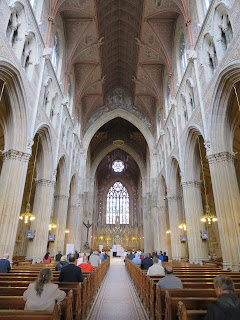


However, one element of the pilgrimage above all made it a most blessed occasion, the presence of His Eminence Seán, Cardinal Brady, Archbishop Emeritus of Armagh, to celebrate the Mass. In his homily, Cardinal Brady reminded the congregation that the Traditional Latin Mass had been the Mass of his Altar service, of his First Communion and Confirmation, and of his Ordination and his First Mass. He also reminded us that this day, the feast of St. John the Baptist, was his own feast day. Cardinal Brady is to attend the Consistory on 28th June with Our Holy Father, Pope Francis. His Eminence was assisted by Fr. Aidan McCann, C.C., who was ordained in the Cathedral only two years ago. It was a great privilege and joy for the members and friends of the Catholic Heritage Association to share so many grace-filled associations with Cardinal Brady and Fr. McCann and the Armagh Cathedral community.


Monday, 24 April 2017
Cormac MacCulinan and the Foundations of the See of Cashel
From Fr. Thomas Walsh's Ecclesiastical History of Ireland c. xx, p. 191-194
The see of Cashel was founded in the tenth century by Cormac MacCulinan in whose person the mitre and sceptre were united. Before the time of this prelate, Cashel, though the residence of the kings of Munster, was subject to the jurisdiction of the see of Emly. In the council of Kells held in 1152 under Cardinal Paparo, Cashel was raised to the archiepiscopal dignity and its prelate invested with the pallium it then ranked next to Armagh and St. Malachy desired to have this mark of distinction which the pallium conferred bestowed on this see as well as Armagh. Cormac erected a cathedral in Cashel which according to the annals of the island of All Saints was afterwards rebuilt and consecrated with great solemnity.
Between the founder Cormac and the council of Kells only four of his successors are mentioned their acts and those of other eminent ecclesiastics having been completely destroyed. Cormac MacCulinan was born in the year 837 and was of the Eugenian branch being lineally descended from Aengus who had been baptized by St Patrick. Having received an ecclesiastical education under Snegdus the erudite abbot of Castle Dermot, he was admitted to holy orders and it seems was after a certain period raised to the episcopacy on account of his extraordinary merit as it was customary in the Irish Church to promote persons who were distinguished to that rank in places where previously no bishops presided.
Some conjecture that he had been bishop of Lismore before his removal to Cashel as a Cormac son of Culinan is stated to have been bishop of that see in those times nor is it easy to admit two bishops sons of Culinan as contemporaries at Cashel and Lismore.
Kingeagan who then swayed the sceptre of the province having incurred the displeasure of his subjects was deposed from that throne of which he obtained possession in the year 895 and Cormac was called to occupy it by his opponents in 901. Some time however elapsed before Cormac obtained quiet possession of the sovereignty. In 902 when Feongaine son of Gorman king of Cashel was slain in a contest by his own people, Cormac the year after obtained the throne without opposition and thus the spiritual and temporal authority were united in the person of Cormac nor was such an union unknown in his days as Olchobair who died in 851 and Cinfeled who departed life in 872 were kings of Munster and bishops of Emly...
Unhappily at this period a martial spirit pervaded the Irish clergy which was so contrary to the feelings of their predecessors it originated in the contests with the Danes and in which the clergy were of necessity involved as they were frequently obliged to take up arms and defend themselves and their establishments against those savage and ruthless invaders. A desperate battle was fought in which Cormac was slain by one Fiacha a herdsman and along with him the abbots MacEogan and Colman, Kelly the prince of Ossory, Fogarty prince of Kerry and about six thousand of Cormac's forces were put to the sword. Before the engagement Cormac made his confession to Comghall and also prepared his will in which he bequeathed sacred ornaments and utensils gold and silver to various churches and religious places, Cashel, Lismore, Emly, Armagh, Kildare, Glendaloch, Inniscathy and Mungairid. It is said that his body was conveyed to Cashel and there interred According to another account he was buried at Castledermot. This prelate was the author of the celebrated work the Psalter of Cashel in which the ancient events of Irish history are chronologically treated. He also compiled an Irish glossary and a work on the genealogies of the Irish saints. Cormac erected a small but beautiful chapel on the summit of the rock in the city of Cashel. Cormac MacCullenan governed the province of Munster for the space of seven years and during his reign acquired the character of a just and learned prince. Fortune smiled upon him his power was dreaded and by his subjects he was revered because of his many virtues.
The see of Cashel was founded in the tenth century by Cormac MacCulinan in whose person the mitre and sceptre were united. Before the time of this prelate, Cashel, though the residence of the kings of Munster, was subject to the jurisdiction of the see of Emly. In the council of Kells held in 1152 under Cardinal Paparo, Cashel was raised to the archiepiscopal dignity and its prelate invested with the pallium it then ranked next to Armagh and St. Malachy desired to have this mark of distinction which the pallium conferred bestowed on this see as well as Armagh. Cormac erected a cathedral in Cashel which according to the annals of the island of All Saints was afterwards rebuilt and consecrated with great solemnity.
Between the founder Cormac and the council of Kells only four of his successors are mentioned their acts and those of other eminent ecclesiastics having been completely destroyed. Cormac MacCulinan was born in the year 837 and was of the Eugenian branch being lineally descended from Aengus who had been baptized by St Patrick. Having received an ecclesiastical education under Snegdus the erudite abbot of Castle Dermot, he was admitted to holy orders and it seems was after a certain period raised to the episcopacy on account of his extraordinary merit as it was customary in the Irish Church to promote persons who were distinguished to that rank in places where previously no bishops presided.
Some conjecture that he had been bishop of Lismore before his removal to Cashel as a Cormac son of Culinan is stated to have been bishop of that see in those times nor is it easy to admit two bishops sons of Culinan as contemporaries at Cashel and Lismore.
Kingeagan who then swayed the sceptre of the province having incurred the displeasure of his subjects was deposed from that throne of which he obtained possession in the year 895 and Cormac was called to occupy it by his opponents in 901. Some time however elapsed before Cormac obtained quiet possession of the sovereignty. In 902 when Feongaine son of Gorman king of Cashel was slain in a contest by his own people, Cormac the year after obtained the throne without opposition and thus the spiritual and temporal authority were united in the person of Cormac nor was such an union unknown in his days as Olchobair who died in 851 and Cinfeled who departed life in 872 were kings of Munster and bishops of Emly...
Unhappily at this period a martial spirit pervaded the Irish clergy which was so contrary to the feelings of their predecessors it originated in the contests with the Danes and in which the clergy were of necessity involved as they were frequently obliged to take up arms and defend themselves and their establishments against those savage and ruthless invaders. A desperate battle was fought in which Cormac was slain by one Fiacha a herdsman and along with him the abbots MacEogan and Colman, Kelly the prince of Ossory, Fogarty prince of Kerry and about six thousand of Cormac's forces were put to the sword. Before the engagement Cormac made his confession to Comghall and also prepared his will in which he bequeathed sacred ornaments and utensils gold and silver to various churches and religious places, Cashel, Lismore, Emly, Armagh, Kildare, Glendaloch, Inniscathy and Mungairid. It is said that his body was conveyed to Cashel and there interred According to another account he was buried at Castledermot. This prelate was the author of the celebrated work the Psalter of Cashel in which the ancient events of Irish history are chronologically treated. He also compiled an Irish glossary and a work on the genealogies of the Irish saints. Cormac erected a small but beautiful chapel on the summit of the rock in the city of Cashel. Cormac MacCullenan governed the province of Munster for the space of seven years and during his reign acquired the character of a just and learned prince. Fortune smiled upon him his power was dreaded and by his subjects he was revered because of his many virtues.
Friday, 22 May 2015
Prayer for the Church in Ireland
God of our fathers,
renew us in the faith which is our life and salvation,
the hope which promises forgiveness and interior renewal,
the charity which purifies and opens our hearts
to love you, and in you, each of our brothers and sisters.
Lord Jesus Christ,renew us in the faith which is our life and salvation,
the hope which promises forgiveness and interior renewal,
the charity which purifies and opens our hearts
to love you, and in you, each of our brothers and sisters.
may the Church in Ireland renew her age-old commitment
to the education of our young people in the way of truth and goodness, holiness and generous service to society.
Holy Spirit, comforter, advocate and guide,
inspire a new springtime of holiness and apostolic zeal
for the Church in Ireland.
May our sorrow and our tears,
our sincere effort to redress past wrongs,
and our firm purpose of amendment
bear an abundant harvest of grace
for the deepening of the faith
in our families, parishes, schools and communities,
for the spiritual progress of Irish society,
and the growth of charity, justice, joy and peace
within the whole human family.
To you, Triune God,
confident in the loving protection of Mary,
Queen of Ireland, our Mother,
and of Saint Patrick, Saint Brigid and all the saints,
do we entrust ourselves, our children,
and the needs of the Church in Ireland.
Amen.
Pope Benedict XVI
19th March, 2010
Solemnity of St. Joseph
Sunday, 19 April 2015
National Latin Mass Pilgrimage to Armagh Cathedral
The Irish are very devoted to pilgrimage. In the Golden Age of Faith the Saints of Ireland undertook Peregrinatio Pro Christo to Heaven-knew-where to bring them the Catholic Faith. It is a startlingly rare thing to make a pilgrimage to Armagh, the seat of Saint Patrick, the Apostle of Ireland, and his successor the Primate of All Ireland, and, in a sense, the spiritual heart and ecclesiastical capital of Ireland.
The present Cathedral, the National Cathedral, as Cardinal Logue called it, was built between 1840 and 1904, the medieval Cathedral having been confiscated during the 16th century. Historic images of the Cathedral can be seen here.


The present Cathedral, the National Cathedral, as Cardinal Logue called it, was built between 1840 and 1904, the medieval Cathedral having been confiscated during the 16th century. Historic images of the Cathedral can be seen here.
Monday, 6 April 2015

Subscribe to:
Posts (Atom)